
Sill Bearing
Choosing a China Ball Bearing Shaft manufacturer requires more than comparing prices or reading polished factory profiles. It requires evidence.
The global bearing market continues to expand with industrial automation, electric vehicles, wind power, and machine-tool demand. Grand View Research reported strong growth in the global ball bearing market, while MarketsandMarkets identified automation and energy-efficient equipment as important demand drivers. These reports describe market direction, not supplier quality. The difference matters.
A reliable supplier should show measurable control over shaft diameter, hardness, roundness, surface roughness, and bearing fit. A finished shaft should not merely look bright under factory lighting. Its critical journal should remain stable under load, heat, vibration, and repeated rotation. ISO 281 provides a recognized method for calculating bearing life, but shaft accuracy still affects the final result.
Bearing specialist Tedric A. Harris emphasized this practical principle: “A bearing is not an isolated component; it is part of a system.” That sentence deserves attention. A strong shaft may still fail with poor lubrication, incorrect clearance, or misalignment.
This guide examines China-based manufacturers through production capability, material traceability, inspection equipment, export experience, and technical communication. It also considers less visible details, such as packaging against corrosion and the supplier’s response after delivery. Market statistics can guide research. They cannot replace factory audits or sample testing. That is the uncomfortable part.
The best supplier is not always the largest one. It is the one that can repeatedly prove its claims with records, tolerances, test results, and accountable engineering support.
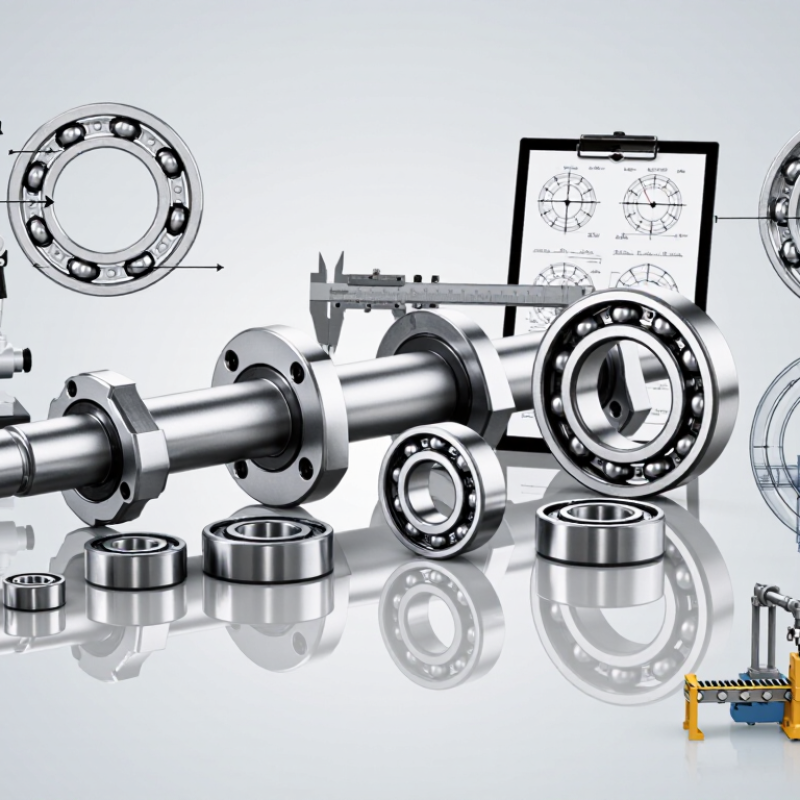
A ball bearing shaft is a rotating shaft supported by ball bearings. The bearing’s inner ring fits around the shaft, while the outer ring sits inside a housing. Small hardened balls separate both rings and reduce sliding friction. This arrangement lets the shaft transfer torque while rotating smoothly under radial or limited axial loads.
The shaft must remain straight, correctly sized, and properly finished. Even a small surface defect can damage the bearing seat. ISO 281:2007 evaluates bearing rating life through load, speed, and reliability calculations. Its basic rating life, L10, represents the operating life reached by 90% of identical bearings under defined conditions. It is useful, but not a promise for every machine.
A shaft does more than “hold” a bearing. It controls alignment, transmits power, and helps manage vibration through the entire assembly. The U.S. Department of Energy reports that motor-driven systems consume a major share of industrial electricity, making rotating efficiency commercially important. Poor lubrication remains a practical weakness. Dust, moisture, excessive preload, or incorrect mounting can shorten service life sharply.
In field inspections, checking runout, shaft hardness, shoulder squareness, and bearing clearance can reveal problems before overheating begins. However, calculations alone can mislead. Real loads change, installation quality varies, and operators may ignore early noise. A reliable China-based ball bearing shaft supplier should provide dimensional inspection records, material certificates, balancing results, and traceable quality controls.
China’s ball bearing shaft production usually begins with alloy steel bars selected for strength, hardness, and dimensional stability. Engineers review the shaft drawing, load requirements, and operating speed before machining starts. This prevents expensive changes later.
The bars are cut into blanks, then turned on CNC lathes. A typical shaft may receive centerless grinding, shoulder machining, threading, and polishing. Heat treatment follows when the design requires higher wear resistance. Technicians monitor furnace temperature and holding time closely. Even small variations can affect hardness.
After machining, inspectors check diameter, roundness, surface roughness, and runout. Calipers are useful, but precision micrometers and coordinate measuring machines provide stronger evidence. Workers also inspect raceway contact areas under magnification. No production line is perfect. Tool wear, material stress, or an overlooked burr can still create problems. In my view, reliable suppliers should keep traceable inspection records and explain how rejected parts are controlled.
Tips: Ask for material certificates, heat-treatment reports, and sample inspection data. Confirm tolerance requirements before production. A pre-production sample helps reveal fit issues early. Do not judge a supplier only by a polished factory video. Check process capability, measurement equipment, packaging protection, and communication during trial orders. Small details matter.
Choosing a China ball bearing shaft manufacturer requires more than comparing prices. Material traceability matters.
Common shaft materials include AISI 4140, AISI 4340, and bearing steel equivalent to EN 1.3505. These alloys offer strength, fatigue resistance, and stable heat treatment. For humid environments, martensitic stainless steel can provide better corrosion resistance, although it may reduce load capacity.
The World Steel Association reported about 1.89 billion tonnes of crude steel production in 2023. That figure shows supply scale, not material quality. Each batch still needs chemical analysis, ultrasonic inspection, and inclusion control. ASTM E45 procedures help evaluate nonmetallic inclusions in bearing steel. Small defects matter.
For dimensional control, ISO 1101 supports geometric tolerancing, while ISO 21920 addresses surface texture measurement. ISO 492 is useful when shaft dimensions interface directly with rolling bearings. Typical hardened bearing surfaces may reach approximately 58–64 HRC, depending on grade and application. A polished shaft can still fail if runout remains excessive. This is often overlooked.
In practical inspection, suppliers should provide hardness maps, material certificates, heat-treatment records, and final inspection reports. Critical journals may require micrometer-level diameter control, controlled chamfers, and low surface roughness. The exact tolerance depends on bearing clearance and operating speed. Over-specification can increase cost without improving service life. That deserves review.
| Evaluation Dimension | Typical Requirement or Data | Applicable Standard or Reference | Quality Significance |
|---|---|---|---|
| Common Bearing-Steel Material | Through-hardening chromium bearing steel, commonly specified as 100Cr6, SAE 52100, or GCr15 equivalents. | ISO 683-17; ASTM A295; GB/T 18254 | Provides high rolling-contact fatigue resistance, wear resistance, and dimensional stability after heat treatment. |
| Typical Chemical Composition | For 100Cr6-type steel: carbon approximately 0.93–1.05%, chromium approximately 1.35–1.60%, manganese approximately 0.25–0.45%, silicon approximately 0.15–0.35%, with phosphorus and sulfur controlled at low levels. | ISO 683-17 and the purchaser’s approved material grade | Carbon supports hardness; chromium improves hardenability and wear resistance. Exact limits depend on the selected national or international grade. |
| Alternative Shaft Materials | Martensitic stainless steel such as 440C may be used for corrosion resistance; precipitation-hardening stainless steel such as 17-4 PH may be used when strength and corrosion resistance are required. | ASTM A564/A564M; ASTM A276/A276M | Material selection should consider humidity, chemicals, load, temperature, magnetic requirements, and required hardness. |
| Heat Treatment | Through-hardening followed by tempering is typical for bearing steel. The process should include controlled austenitizing, quenching, tempering, and dimensional stabilization when required. | ISO 683-17; approved process specification | Correct heat treatment produces a hard wear-resistant surface while limiting distortion and retained austenite. |
| Typical Working Hardness | Approximately 58–64 HRC for hardened 100Cr6/52100-type bearing steel, subject to shaft diameter, heat-treatment route, and design requirements. | ISO 6508-1 for Rockwell hardness testing | Hardness must be verified at defined locations because excessive hardness variation can reduce fatigue life or increase brittleness. |
| Core Toughness and Hardness Profile | Requirements should define surface hardness, core hardness, effective hardened depth, and allowable hardness variation rather than relying only on an average value. | ISO 6507-1 or ISO 6508-1; drawing-specific requirements | A controlled hardness profile helps prevent premature cracking, indentation, and deformation under bearing loads. |
| Dimensional Tolerance | Shaft diameter, length, roundness, cylindricity, runout, and bearing-seat tolerance should be stated individually on the engineering drawing. | ISO 286-1; ISO 286-2 | Proper fits control creep, mounting force, bearing clearance, and shaft alignment. The required fit depends on load direction, speed, and temperature. |
| Bearing-Seat Fit | Common fit classes include h6, j6, k6, m6, or other specified classes; the correct selection depends on the rotating ring, load, and operating conditions. | ISO 286-2; bearing manufacturer’s fit recommendations | A fit that is too loose can cause fretting and creep, while an excessive interference fit can reduce internal bearing clearance. |
| Surface Roughness | Precision bearing seats commonly require a finely ground finish. A representative design target may be Ra 0.2–0.8 µm, but the final value must come from the drawing and bearing interface. | ISO 21920-1; ISO 21920-2 | Low and consistent roughness improves seating, reduces fretting, and supports stable bearing performance. |
| Geometric Accuracy | Control total runout, circular runout, cylindricity, perpendicularity, concentricity, and shoulder squareness according to the shaft design. | ISO 1101 | Geometric errors can create misalignment, uneven load distribution, vibration, and shortened bearing life. |
| Surface Integrity | The bearing seat should be free from grinding burns, laps, seams, folds, cracks, burrs, and sharp edge damage. Chamfers should be compatible with the bearing ring geometry. | ISO 18203; drawing and inspection plan | Surface defects can act as crack initiators or prevent the bearing from seating correctly. |
| Non-Metallic Inclusions | Oxide, sulfide, silicate, and globular inclusion levels should be controlled and assessed using a defined cleanliness method. | ISO 4967; ASTM E45 | Low inclusion content is important for rolling-contact fatigue resistance and consistency in high-load or high-speed applications. |
| Ultrasonic or Internal Defect Inspection | Ultrasonic testing may be specified for critical shafts to detect internal discontinuities such as inclusions, voids, or cracks. | ISO or ASTM customer-approved ultrasonic procedure | Non-destructive inspection reduces the risk of hidden internal defects in safety-critical or continuously operating assemblies. |
| Dimensional Inspection Equipment | Use calibrated micrometers, air gauges, roundness testers, surface profilometers, and coordinate measuring machines where appropriate. | ISO 17025 for laboratory competence; ISO 10012 for measurement management | Traceable measurement equipment improves repeatability and confirms that critical dimensions are within tolerance. |
| Material Traceability | Each production batch should be linked to a material certificate, heat number, heat-treatment record, inspection results, and final packing documentation. | ISO 9001 quality-management practices; purchaser-specific requirements | Traceability supports root-cause analysis, consistent production, and verification of the specified steel grade. |
| Corrosion Protection and Packaging | Clean, dry surfaces should be protected with a compatible rust preventive and sealed packaging. Contact materials should not introduce contamination. | Purchaser packaging specification; storage-condition requirements | Appropriate protection prevents corrosion, staining, and handling damage before installation. |
| Recommended Documentation | Material certificate, chemical analysis, heat-treatment chart, hardness report, dimensional report, surface-roughness report, non-destructive test report, and certificate of conformity. | ISO 9001-based inspection documentation | Complete documentation allows objective supplier comparison and confirms compliance with the approved drawing and purchase specification. |
Choosing a reliable Chinese ball bearing shaft manufacturer requires more than comparing quotations. I once treated a polished sample as proof of quality. It was not. Ask for material certificates, hardness records, dimensional reports, and batch traceability. Critical measurements include shaft diameter, roundness, surface roughness, and bearing-seat runout. Request actual inspection data, not blank templates. A capable supplier should explain its heat-treatment controls and corrective-action process clearly.
The 2023 ISO Survey recorded more than 1.26 million ISO 9001 certificates worldwide, but certification alone cannot guarantee consistent parts. Verify the certificate scope and audit the production site. Check whether inspectors use calibrated gauges and whether records link each shaft to a production lot. The International Organization for Standardization also emphasizes documented processes and customer-focused quality controls. Useful evidence includes sample fatigue testing, cleanliness checks, and dimensional results from several batches. Ask for a pilot order before signing a long-term agreement. Measure the delivered parts independently. Small deviations matter. A 0.01-millimeter error can affect fit, vibration, and service life. Industry market reports forecast continued growth in bearing demand, increasing pressure on suppliers to scale quickly. Fast growth can expose weak process control. Do not ignore communication quality either. Slow technical replies often predict slower problem resolution. My own checklist would include factory capacity, export experience, inspection transparency, packaging protection, and written responsibility for nonconforming goods. It may still miss something. That is why staged verification remains safer than trusting promises.
This chart shows the specified chemical-composition ranges of two commonly referenced bearing-steel grades used in supplier quality checks. The values are percentage limits by mass based on GB/T 18254 bearing-steel specifications. When evaluating a Chinese manufacturer or supplier, request material certificates and verify that production batches remain within the applicable specification ranges.
Ball bearing shafts support rotating equipment across manufacturing, transport, energy, and agricultural operations. In electric motors, pumps, conveyors, gearboxes, and machine tools, they reduce friction while maintaining accurate rotation. The U.S. Department of Energy reports that motor-driven systems consume about 68% of industrial electricity in the United States. This makes efficient shaft and bearing design commercially important, not merely mechanical.
Automotive wheel hubs demand impact resistance and stable performance under changing loads. Conveyor systems need dependable rotation near dust, vibration, and frequent starts. In wind turbines and industrial fans, shaft alignment directly affects heat, noise, and service life. ISO 281 provides methods for calculating bearing rating life, while ISO 76 addresses static load capacity. These standards improve comparison, but real installations are less tidy than catalogs suggest. Contamination, poor lubrication, and small alignment errors still cause many failures. A stronger shaft cannot correct every design mistake.
Tips: Match shaft diameter, load direction, speed, sealing, and operating temperature before choosing a bearing assembly. Check hardness and surface finish near the bearing seat. Ask suppliers for dimensional inspection records, material certificates, and life calculations. The International Energy Agency reports that industry uses roughly 37% of global final energy, so reducing mechanical losses has practical value. Still, energy savings should be verified under real operating conditions. Laboratory figures can look perfect; factory floors rarely do.
Common choices include high-strength alloy steel, tough nickel-chromium steel, and bearing-grade steel.
Traceability links each shaft to its material batch, heat treatment, and inspection records.
Request chemical analysis, ultrasonic inspection, cleanliness checks, hardness testing, and dimensional reports.
Hardened bearing surfaces often reach about 58–64 HRC, depending on grade and application.
Check diameter, roundness, surface roughness, chamfer size, and bearing-seat runout.
No. A shaft can look smooth while excessive runout causes vibration or uneven bearing contact.
Ask for material certificates, hardness maps, heat-treatment records, and real inspection data.
A pilot order is safer than immediate long-term commitment.
A Ball Bearing Shaft is a precision component that combines a rotating shaft with bearing support to reduce friction, maintain alignment, and transfer motion efficiently. It is commonly used where smooth rotation, stable load handling, and long service life are essential. In China, manufacturers typically produce these components through processes such as material cutting, turning, heat treatment, grinding, polishing, and strict dimensional inspection. These steps help achieve accurate tolerances, balanced rotation, and reliable performance.
When selecting a Chinese manufacturer or supplier, buyers should evaluate material quality, production capabilities, inspection procedures, customization services, lead times, and communication. Common materials include hardened bearing steel, stainless steel, and other engineered alloys chosen according to load, speed, corrosion exposure, and operating temperature. Quality standards should cover hardness, surface finish, roundness, concentricity, and durability. Ball Bearing Shafts are widely applied in automation equipment, electric motors, conveyors, pumps, machine tools, agricultural machinery, and various industrial systems. A dependable supplier should provide consistent quality, clear technical documentation, and suitable support from design to delivery.
