
Sill Bearing
For global buyers, choosing the 2026 best Industrial Ball Bearings means matching proven performance to real operating conditions. A bearing that runs smoothly in a clean test room may struggle in a dusty plant, a washdown line, or equipment facing repeated start-stop cycles. Buyers should compare load ratings, speed limits, sealing, lubrication needs, material quality, and traceable inspection records—not price alone.
Quality expert W. Edwards Deming is widely associated with the principle, “Quality is everyone’s responsibility.” Applied to bearing procurement, that means engineers, suppliers, and purchasing teams all need clear specifications and consistent checks. Ask for documented tolerances, batch traceability, and test evidence. Confirm that dimensions and fits match the shaft and housing. Small mismatches matter. A micrometer reading, a rough raceway, or a seal that sits unevenly can shorten service life.
This guide examines bearing types, materials, supplier capability, and practical selection criteria for international sourcing. It also considers delivery consistency, technical support, and total cost over the bearing’s service life. No single product is best for every application. Some buyers may still prioritize a low unit price; that choice deserves a closer look. Without comparable test data and operating details, any “best” list has limits. The aim here is to help buyers ask sharper questions and make decisions they can verify.
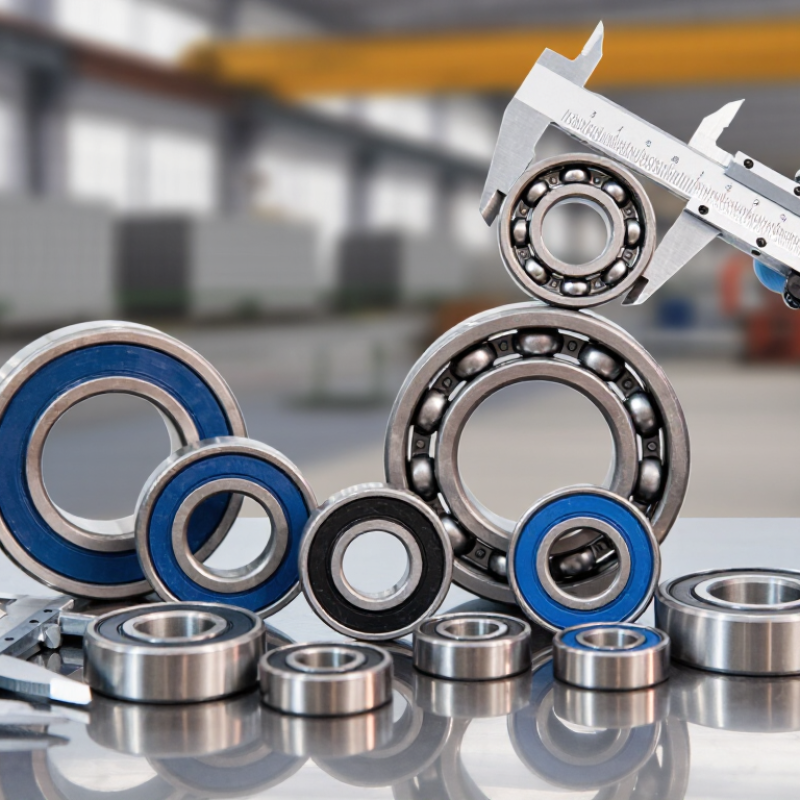
Industrial ball bearings support radial loads, and some designs also handle axial loads. Their main parts are inner and outer rings, rolling elements, a cage, and lubricant. As the shaft turns, balls roll between the raceways, spreading the load across small contact areas. The cage spaces the balls; it does not carry the main load. Small parts matter. ISO 281:2007 defines basic rating life using a 90% reliability basis, giving engineers a consistent way to compare calculated bearing life.
Selection depends on more than bore size. Load direction, speed, temperature, contamination, lubrication, and shaft alignment all affect operation. A U.S. Department of Energy industrial motor-systems sourcebook reports that motor systems use about 70% of U.S. industrial electricity. That figure is not a bearing-savings estimate, but it shows why friction, fit, and maintenance deserve attention. A bearing can meet its calculated life and still fail early if a seal leaks or grease is unsuitable. Drawings help; operating conditions can be messier.
Tips: Check load and speed against the bearing rating, then verify fit and lubrication. Keep dust out during installation. If wear patterns look uneven, recheck alignment before replacing parts. This practical check is easy to skip.
Types of Ball Bearings and Their Industrial Applications
Ball-bearing selection begins with load direction, speed, and operating environment. Deep-groove bearings suit electric motors, fans, and conveyors, where radial loads dominate. Angular-contact bearings manage combined radial and axial loads, making them common in pumps and machine-tool spindles. Thrust ball bearings carry axial loads, such as those created by vertical shafts. Self-aligning types tolerate some shaft misalignment, though they may offer less rigidity. Small details matter: dust, lubricant choice, and a poorly aligned housing can shorten service life.
The International Energy Agency’s report, Energy-Efficiency Policy Opportunities for Electric Motor-Driven Systems, estimates that motor-driven systems account for about 69% of industrial electricity use. That figure does not mean bearings alone determine energy consumption. Still, in motors and pumps, suitable bearing selection and maintenance can help reduce friction-related losses and unplanned stoppages. Buyers should compare load ratings, limiting speed, clearance, sealing, and expected temperature—not just bore size. One overlooked fit can cause trouble.
Tips: Match the bearing to the actual load and duty cycle. Check alignment and lubrication during installation; catalog selection alone is not enough.
| Bearing Type | Design Characteristics | Load Suitability | Speed and Alignment Considerations | Typical Industrial Applications | Key Selection Considerations |
|---|---|---|---|---|---|
| Deep-Groove Ball Bearing | Single- or double-row design with deep raceway grooves; available in open, shielded, or sealed configurations. | Primarily radial loads; can also accommodate moderate axial loads in both directions. | Suitable for high-speed operation when correctly selected and lubricated; requires reasonably accurate shaft and housing alignment. | Electric motors, pumps, fans, conveyors, gearboxes, and general-purpose machinery. | A versatile choice for common radial-load applications. Consider sealing, internal clearance, lubrication, noise requirements, and operating temperature. |
| Angular-Contact Ball Bearing | Raceways are arranged to support combined loading; commonly used as single bearings or in matched pairs. | Supports radial loads and axial loads in one direction; paired arrangements can support axial loads in both directions. | Often selected for precision and higher-speed rotating systems; paired mounting and preload may be required for stiffness. | Machine-tool spindles, pumps, compressors, precision gearboxes, and high-speed drive systems. | Check contact angle, arrangement, preload, stiffness, speed requirements, and the direction and magnitude of axial loading. |
| Self-Aligning Ball Bearing | Two rows of balls run on a common spherical outer raceway, allowing the bearing to accommodate limited misalignment. | Primarily radial loads; axial capacity is generally limited compared with radial capacity. | Accommodates angular misalignment caused by shaft deflection or mounting error; allowable misalignment depends on bearing design and operating conditions. | Long-shaft drives, agricultural machinery, textile equipment, conveyors, and applications with flexible or difficult-to-align structures. | Useful where alignment cannot be maintained precisely. Verify shaft and housing fits, load level, and the permitted misalignment for the selected design. |
| Thrust Ball Bearing | Uses washer-shaped raceways with ball-and-cage assemblies; available in single-direction and double-direction designs. | Designed mainly for axial loads; generally not intended to carry significant radial loads. | Operating speed and load capacity depend on the design, lubrication, and mounting arrangement; shaft and housing alignment must be considered. | Vertical shafts, turntables, lifting equipment, screw jacks, and low-to-moderate-speed axial support positions. | Confirm whether axial load acts in one or both directions. Provide separate radial support where the application requires it. |
| Four-Point-Contact Ball Bearing | Split inner or outer ring design creates four possible contact points; can provide axial support in both directions in a compact arrangement. | Primarily suited to axial loads in both directions, with limited radial-load capability depending on the design. | Can reduce the space required for axial location; operating performance depends on fit, clearance, load distribution, and lubrication. | Gearboxes, industrial robots, indexing tables, and machinery requiring compact axial location. | Assess the combined load, required axial positioning, stiffness, and whether a separate radial-support bearing is needed. |
| Double-Row Angular-Contact Ball Bearing | Two rows of balls in a compact unit, typically providing axial support in both directions. | Supports combined radial and axial loads; axial capacity is available in both directions. | Offers greater axial support than many single-row arrangements, but speed limits and rigidity depend on the specific design. | Water pumps, industrial fans, agricultural equipment, and compact assemblies with combined loading. | Check the required axial load, available mounting space, internal clearance, sealing, and lubrication method. |
Selection note: Speed limits, load ratings, service life, and permitted misalignment vary by bearing size, material, cage, precision class, lubrication, fits, and operating conditions. Confirm application-specific values with the relevant technical documentation and engineering calculations.
Comparing industrial ball bearings in 2026 starts with the machine, not a catalog ranking. Record radial and axial loads, shaft speed, start-stop frequency, and expected operating hours. A conveyor idler running steadily faces different demands from a pump with frequent starts. Check dynamic and static load ratings, then verify them against the real duty cycle. Heat changes everything. High speed can raise temperature, while excess preload may increase friction and shorten lubricant life.
Fit and environment matter just as much. Measure shaft and housing tolerances, and specify internal clearance for the actual temperature range. In a washdown area, seals and corrosion resistance deserve close review; in dusty service, contamination control may matter more than a higher speed limit. Check lubrication type, relubrication access, vibration limits, and noise requirements. Ask for material details and inspection records, not just a polished data sheet. A neat specification sheet can still mislead.
Compare operating costs, including energy loss, maintenance labor, and replacement downtime. Confirm dimensions and mounting details before ordering, especially when replacing an existing unit. Measure twice. Supplier test data can help, but check whether test conditions resemble your application. Field feedback is useful, though one installation cannot prove long-term performance. Keep selection notes; they reveal assumptions that may need revisiting after the first service interval.
For global buyers, bearing material should match the load, speed, temperature, and operating environment. Through-hardened bearing steel suits many general industrial applications. Stainless steel can help where moisture or frequent cleaning is expected, though it is not immune to corrosion. Hybrid bearings combine steel rings with ceramic rolling elements for selected high-speed or electrically demanding applications. There is no universal best material.
Standards make supplier comparisons more useful. ISO 492 covers dimensional and running accuracy tolerances, while ISO 281 provides methods for calculating rating life. Buyers should confirm the applicable standard and edition in the purchase specification. A stated standard alone does not prove consistent production quality. Ask for material certificates, heat-treatment records, and lot-level traceability. Details matter.
Incoming checks should match the bearing’s intended duty. Verify key dimensions, hardness, surface condition, and packaging; for demanding equipment, consider noise or vibration data. A smooth sample is reassuring, but it cannot represent every production lot. Specifications can also overlook real operating conditions, such as dust entering through a damaged seal. Share the expected load, lubrication, and maintenance environment with the supplier, then define acceptance criteria before shipment.
Selecting an industrial ball bearing begins with the operating conditions, not a catalog headline. Record shaft size, radial and axial loads, speed, temperature, and exposure to dust or moisture. A bearing beside a washdown area needs different sealing than one inside a clean gearbox. Check required clearance, lubrication method, and mounting fit as well. A high load rating alone does not guarantee a long service life. Small details matter.
Evaluate suppliers by asking for clear technical documents and consistent quality records. Useful evidence includes dimensional inspection results, material information, batch traceability, and details of testing procedures. Ask how the supplier handles nonconforming parts and whether production capacity can support repeat orders. Confirm lead times and packaging; a damaged seal or mixed batch can create problems before installation. Ask for evidence. Samples can help, but inspect them against your actual drawing and requirements.
Share your application data and ask the supplier to explain its bearing recommendation, including its assumptions. Compare answers, not just prices. Vague claims about durability deserve follow-up questions. It is easy to overlook lubricant compatibility or installation tools when deadlines are tight; those omissions can matter later. No supplier can remove every risk, and a polished datasheet is not a substitute for checking parts on arrival. Keep the evaluation practical, documented, and tied to the machine’s real working conditions.
It has inner and outer rings, balls, a cage, and lubricant. The balls roll along raceways and spread the load. The cage keeps them spaced; it does not carry the main load.
Most support radial loads, and some designs also handle axial loads. Check the bearing’s ratings against the machine’s actual load direction and duty cycle. A conveyor and a frequently starting pump may need different choices.
Record load, speed, start-stop frequency, temperature, and operating hours. Also check shaft alignment, fit, internal clearance, and contamination. Bore size alone is not enough.
High speed can raise operating temperature. Excess preload can increase friction and shorten lubricant life. Small setup errors matter.
Through-hardened steel suits many general industrial applications. Stainless steel can help in damp or frequently cleaned areas, but it can still corrode. Hybrid designs use steel rings and ceramic rolling elements for selected applications.
Very important. A leaking seal can let dust or moisture reach the rolling surfaces, while unsuitable grease can contribute to early failure. Check relubrication access and keep parts clean during installation.
Ask for material certificates, heat-treatment records, and lot-level traceability. Confirm dimensions, tolerances, and inspection criteria before shipment. A polished data sheet is not proof of consistent production.
Look for uneven wear, unusual vibration, excess heat, or noise. Recheck alignment and lubrication before replacing parts. One smooth sample is reassuring, but it cannot represent every production lot.
This guide explains how Industrial Ball Bearings are designed, how their main components work together, and how bearing motion supports reliable operation in industrial equipment. It compares common ball-bearing types and their applications, helping readers understand how load direction, speed, alignment, and operating conditions influence the choice of bearing.
For global buyers, the article highlights key performance factors such as load capacity, precision, durability, lubrication needs, and resistance to heat or contamination. It also outlines how materials, recognized standards, and quality controls can inform purchasing decisions. A practical supplier-evaluation approach helps buyers compare technical documentation, manufacturing consistency, communication, and service capabilities, then select a bearing suited to their equipment, working environment, and long-term maintenance requirements.
